

On the morning of 1 June 1813, two men sat facing each other in silence in the city of Lahore.
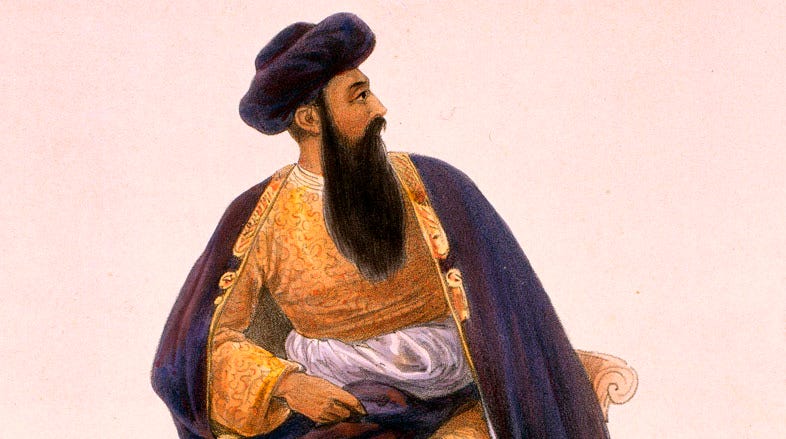
One was Shah Soojah, the exiled King of Afghanistan, a man who had once commanded an empire stretching from Kandahar to Kashmir.
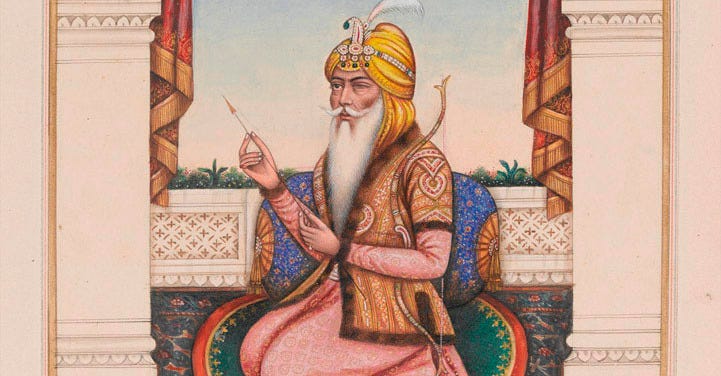
The other was Runjeet Singh, the one-eyed ruler of the Punjab, grandson of a village chief who had begun life as a bandit.
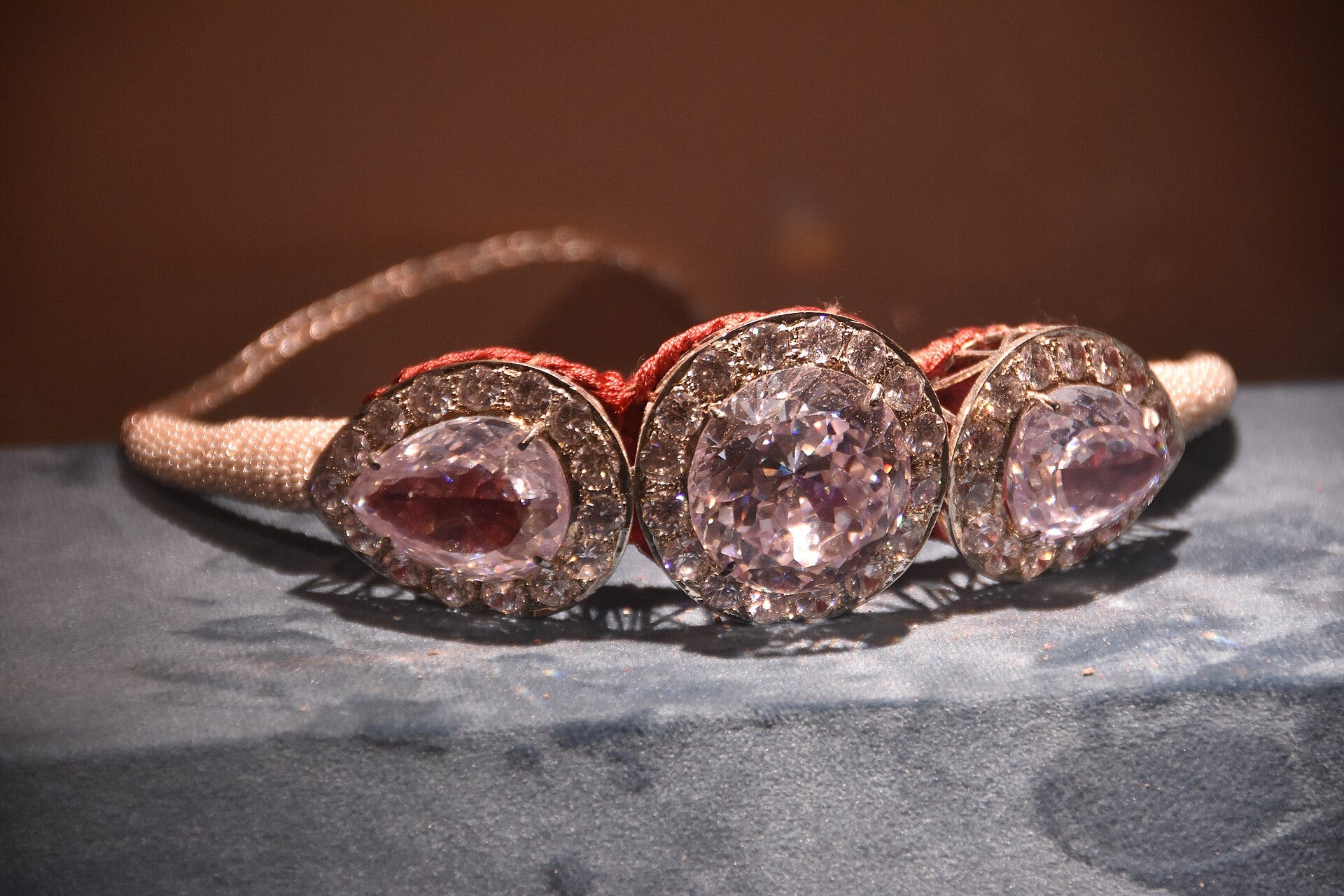
Between them, wrapped in layers of cloth, lay the most coveted object in Asia. A diamond roughly the size of a chicken egg, known to the world as the Koh-i-Noor or translated as the Mountain of Light.
The scene, as described by a native chief who was present and later reported in the British press, provides an insight into the theatrical quality of diplomacy.
Shah Soojah, ‘summoning all the majesty of a race of kings into his dignified countenance,’ attempted to overawe his captor through sheer regal bearing. The silence lasted a full hour.
However, Runjeet Singh ‘could no more read royalty in the glances of a monarch than the Grunth in the manuscript,’ and grew impatient. A whispered word to an attendant in respect of why they were meeting.
At last the Shah, without speaking, signalled to a servant, who placed a small parcel on the ground and unrolled it. There, in the folds of cloth, the Koh-i-Noor appeared. Jewellers standing behind Runjeet Singh confirmed it was genuine.
This remarkable account, published in the Sun newspaper in London on 23 September 1839, is just one of over a hundred British newspaper articles spanning more than four decades — from 1799 to 1846 — that collectively trace the diamond’s passage through the Sikh Empire.
Read together, they offer something no single history book provides: a real time, week by week account of how the diamond was acquired, displayed, fought over, bequeathed and ultimately lost, as seen through the eyes of British journalists, military officers and diplomatic correspondents.
As with all contemporary newspaper reports, some details require caution and careful verification, as not everything reported is entirely accurate.
A Diamond’s Journey to Lahore
The early history of the Koh-i-Noor is tangled in competing legends. It was most likely mined in the diamond fields of southern India, probably at the Kollur mine on the Krishna River, sometime before the fourteenth century, though its earliest documented appearances come later in Mughal sources.
From there it passed through the hands of successive Indian dynasties before reaching the Mughal emperors, who set it in Shah Jahan’s magnificent Peacock Throne in Delhi.
When the Persian ruler Nader Shah sacked Delhi in 1739, he carried the throne and its jewels back to Iran. It was Nader Shah who reportedly gave the diamond the name by which it has been known ever since.
After Nader Shah’s assassination in 1747, the diamond passed to Ahmad Shah Durrani, founder of the Afghan empire and after him tumbled through a succession of his descendants.
By 1809, it was in the possession of Shah Soojah, the deposed King of Kabul, who fled with his household and a cache of jewels into the Punjab.
What happened next was, in effect, plain and simple, a hostage negotiation.
Shah Soojah’s wife, the Waffa Begum, had pledged the diamond to Runjeet Singh in exchange for her husband’s rescue from imprisonment in Kashmir. When the rescue was accomplished and the moment of payment arrived, the royal couple attempted every conceivable way to evade paying.
The British press reported the episode with relish.
The 1839 Sun sketch describes how Shah Soojah first claimed the diamond was pawned in Kandahar. When that failed, Runjeet advanced two lakhs of rupees to redeem it. The deadline passed. The Queen was placed under guard, a polite way of saying she was in effect under house arrest. The household was denied food and water for two days.
When the diamond was finally surrendered on 1 June 1813, Runjeet’s retainers were sent back to strip the royal family of every remaining ornaments recovering in effect the money he had advanced.
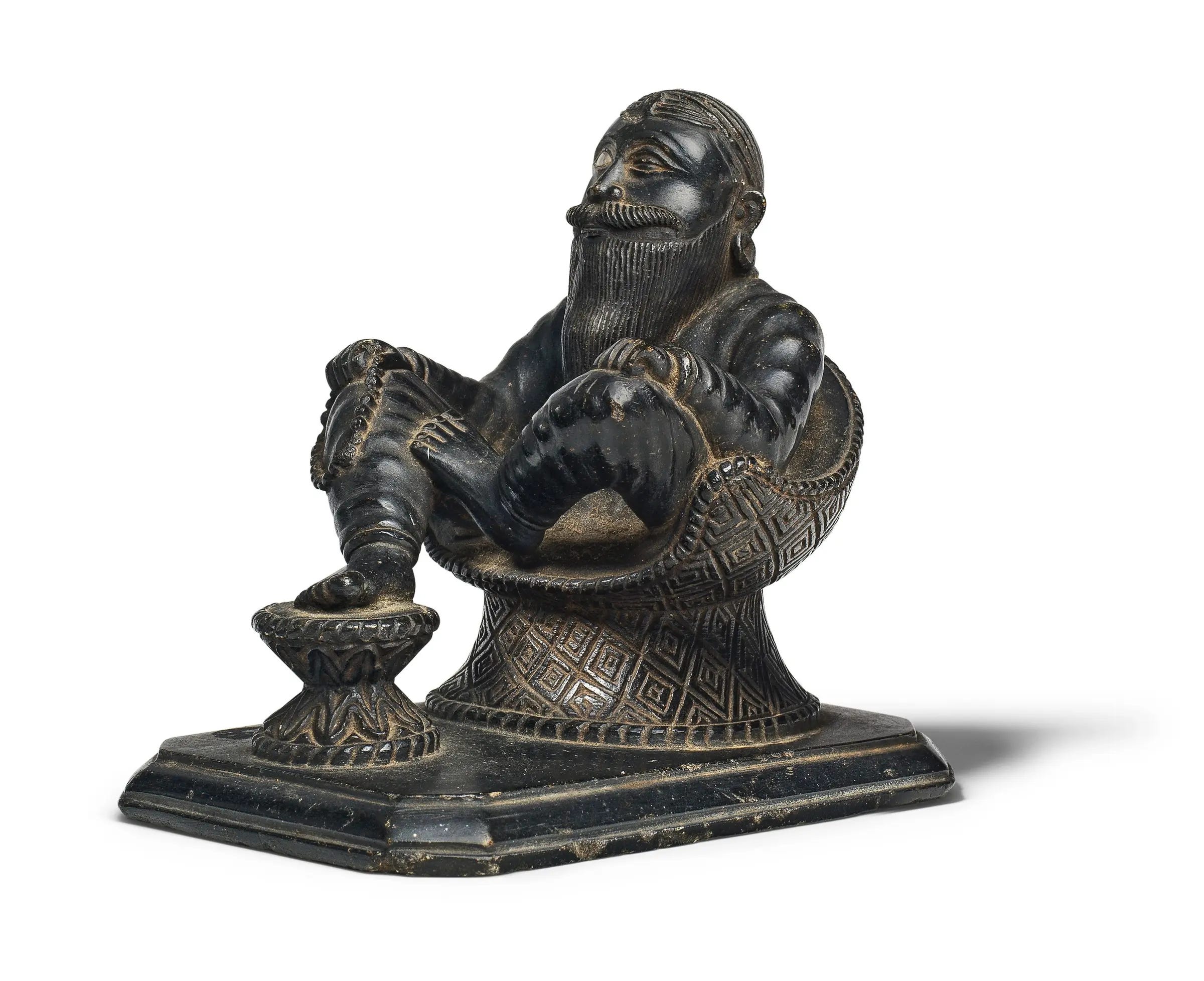
The account is unapologetically hostile to Runjeet Singh calling him ‘the mean-looking and low-minded grandson of a thief’ but the detail it provides is extraordinary, and it helped shape the narrative of how the diamond passed into Sikh hands that later appeared in certain British retellings of the story.
It should be noted, however, that the account is drawn from one perspective among several.
Shah Soojah’s own memoirs tell a different story, claiming that Runjeet Singh had his son tortured in front of him to force the surrender of the diamond.
Sikh accounts argue that Runjeet honoured a debt: the Begum had freely promised the diamond and it was the Afghan couple who acted in bad faith by refusing to honour that pledge.
The truth, as with so much in the Koh-i-Noor’s history, depends on who is telling it and, ultimately, who you want to believe.
A Jewel on Display
Once in Runjeet Singh’s possession, the Koh-i-Noor became central to the spectacle of his court and British correspondents were fascinated.
One of the earliest detailed description appears in the Hull Packet of 16 December 1828, reporting a British mission to the Maharaja’s court. The writer catalogues a scene of staggering opulence: pearl necklaces the size of musket balls, emerald armlets, golden collars on elephants.
But the diamond itself, worn on the Maharaja’s arm, was described as ‘a diamond of vast beauty and magnitude, in shape and size somewhat resembling a pigeon’s egg.’
The most detailed physical description comes from the Sun’s account of the 1833 meeting between Runjeet Singh and Lord William Bentinck, the Governor-General.
Here the Koh-i-Noor is described as ‘of an oval shape, cut like a brilliant,’ roughly half an inch in depth, set in a plain gold armlet between two large heart-shaped diamonds.
The writer noted the deliberate austerity of the setting — gold with an enamelled border, nothing more — on the principle that it would be folly to ‘gild refined gold, or paint the lily.’
Runjeet Singh wore the diamond at major festivals and during meetings with foreign dignitaries and it became inseparable from his public image.
During the Bentinck visit, the Maharaja exhibited all his jewels to Lady William Bentinck. The Koh-i-Noor, an immense topaz, a ruby inscribed with the names of seven previous monarchs and a long emerald nearly three inches in length.
The Koh-i-Noor was not merely ornamental. It was a political statement in itself, proof that the treasures looted from Delhi by Nader Shah in 1739 had been recovered by the sovereign of the Punjab. For Runjeet Singh, wearing it signified that the Sikh kingdom had avenged the humiliations of the 18th century and was now, in many ways, and not for long, the paramount power.
Just to add, the ruby inscribed with the names of seven previous monarchs is almost certainly the Timur Ruby, which is also now in the British Crown Jewels. It also came to Britain through the same route as the Koh-i-Noor, via the Lahore treasury after the annexation of the Punjab.
Death, Sati and a Disputed Bequest
Runjeet Singh died on 27 June 1839, after a protracted illness. The British press covered his death extensively. In the days before he died, he distributed enormous quantities of wealth, from gold and silver howdahs, elephants, horses, precious stones and even cold, hard cash. The cash alone reportedly amounted to three crores of rupees (30 million rupees), roughly equivalent to about £600–650 million today.
The funeral itself was reported with a mixture of fascination and horror. It was reported that four of Runjeet Singh’s wives and seven slave girls were burned on his funeral pyre.
The Bombay Times, reprinted in the Evening Mail on 25 September 1839, condemned the practice in unequivocal terms: ‘The sacrifice of his slaves is indeed an atrocious cruelty, enacted apparently for no other purpose than that of adding dignity to the funeral pageant.’
The procession that carried the ashes towards the Ganges was described in minute detail in the London Dispatch on 29 September 1839. It outlines in detail the golden palanquin, the premier Rajah Dhian Singh walking on foot with a peacock-feather chowry and the favourite horses covered in gold.
The same London Dispatch article reports something quite shocking.
It states that Runjeet Singh had bequeathed the Koh-i-Noor to the chief idol of the Jagannath Temple at Puri.
Yet the bequest was never carried out. In the chaos of the succession crisis that followed, a decade of assassinations, accidental deaths, palace coups and military mutinies, the diamond remained in the Lahore treasury.
The rest of this article is for paid subscribers.
Ranjit Singh was dead. The Koh i Noor was still in Lahore. But over the next decade, the empire that had made the diamond a symbol of Sikh sovereignty began to consume itself.
The rest of this article follows the succession crises, assassinations and wars that brought the Sikh kingdom down, before tracing how an eleven year old Maharaja was made to surrender the Koh i Noor to Queen Victoria.
Paid subscribers get the full story, including more than a hundred contemporary British newspaper reports that follow the diamond from Ranjit Singh’s arm to the Treaty of Lahore and the Tower of London.
Once the Sikh History at the World Cup series is complete, paid subscribers will also get deeper articles on Sikh and British history, alongside the research, sources and fuller stories behind each country in the series.
