
The Language Guru Gobind Singh Wrote In
How three forgotten martial epics reshape what we know about Guru Gobind Singh and Sikh literary history

The association of Sikhs, Punjab and the Punjabi language sits so firmly in the modern imagination that it has become difficult to think anything outside of this.
Punjabi is a Sikh language, the thinking goes, and Punjab is a Sikh land. The community, the geography and the script line up neatly, and that neat alignment is then projected backwards into history, as if it had always been so.
However, as history has a habit of doing, it has not always been so. In fact, when Guru Gobind Singh dictated his own autobiographical poem, the Bacitra Nāṭak, he did not write it in Punjabi but in Brajbhasha.
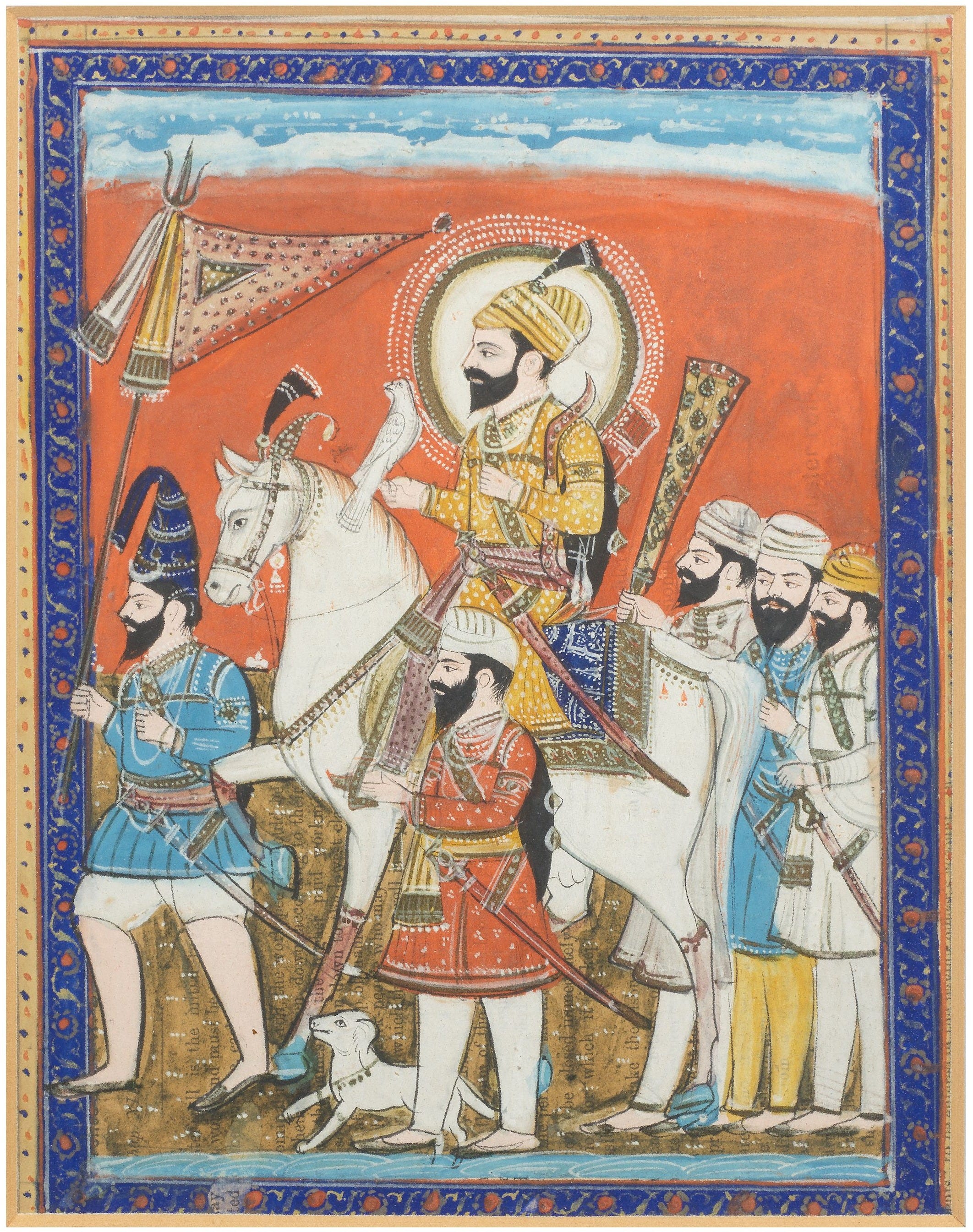
Brajbhasha is a vernacular literary language native to the area around Mathura and Vrindavan, a few hundred miles south east of Anandpur, that had nothing to do with the Punjab in any obvious geographic or ethnic sense.
I came across a paper recently by Julie Vig, an assistant professor at York University whose research focuses on premodern Sikh and Punjabi cultural production, in which she examines this question in close detail through the lens of gurbilās literature, the genre of poetic biographies of the Sikh Gurus that emerged from the late 17th century onwards.
She works through 3 texts, the Bacitra Nāṭak attributed to Guru Gobind Singh himself, Sainapati’s Gur Sobhā completed around 1708 and Kuir Singh’s Gurbilās Pātshāhī Das from the mid-to-late 18th century. Vig shows that all 3 sit inside a much wider Braj literary world, a world that included Rajput martial poetry, the Mughal court and the courtly rīti tradition that had been systematised in the late 16th century by Keshavdas (c. 1555–1617) a Brajbhasha poet from Orchha.
What I found particularly interesting is what this rearrangement of the language map does to our reading of Sikh history. It pulls these texts out of an isolated, Punjab only box and places them within a North Indian literary culture that was multilingual, mobile and far more cosmopolitan than the modern image of Sikh history allows for.
What Is Gurbilās Literature? The Sikh Martial Epics You've Never Heard Of
Gurbilās literally means “the play or pastimes of the Guru.” As a genre, it refers to a body of poetic biographies, written largely in Brajbhasha from the late 17th century into the 19th century, that narrate the life of some of the Gurus, often dwelling at length on his heroic deeds.
The genre is a quietly important one. It is in the Gurbilās Pātshāhī Das that a great deal of what Sikhs today take for granted about the life of the Tenth Guru was first put into written form, and the language in which it was put down was, overwhelmingly, Brajbhasha rather than Punjabi.
The earliest example is the Bacitra Nāṭak, or “Wondrous Drama,” which forms part of the Dasam Granth and is generally attributed to Guru Gobind Singh himself. It is a versified account of his life, divided into 14 chapters, written in Brajbhasha and structured in a variety of metres.
Sainapati’s Gur Sobhā, completed in the 1st decade of the 18th century, is a biographical eulogy of Guru Gobind Singh produced within years of the Guru’s death, written in a mixed Sadhukkari/Brajbhasha.
Kuir Singh’s Gurbilās Pātshāhī Das, the latest of the 3, is a poem just short of 3,000 verses in Brajbhasha, written in the Gurmukhi script, organised across 29 different metre and far more comprehensive and sophisticated in its use of Braj than the Gur Sobhā.
This in itself shows that the use of Brajbhasha was not a one off choice by Guru Gobind Singh. The tradition persisted for more than a century after his death, as Sikhs continued to narrate his life and times in a language that, to the modern mind, seems like the wrong one.
The Battle of Bhangani Through Three Texts: How Sikh Poets Recorded Guru Gobind Singh's First War
The episode Vig uses to pin all 3 texts together is the Battle of Bhangani, fought in 1688 close to Paunta in what is today Himachal Pradesh.
The context, the battle itself, tells us a great deal about why a Sikh poet at the end of the 17th century might use Brajbhasha when describing a battle.
In 1685, Guru Gobind Singh moved from Chak Nanaki to Paunta following an invitation from the chief of Sirmur, Medina Prakash (also known as Mat Prakash), who wanted the Guru to reside in his territory.
The Guru accepted, set up his darbār at Paunta and stayed there until 1688. Paunta sat directly next to the territories of Bhim Chand of Kahlur (Bilaspur) and Fateh Shah of Garhwal, hill chiefs with whom the Guru already had a complicated history of conflict and alliance.
Guru Gobind Singh’s growing displays of power, the size of his retinue and the increasing reputation of his darbār resulted in a serious diplomatic incident with Bhim Chand that culminated in the battle of Bhangani.
The accounts in the 3 gurbilās texts share a remarkable amount of detail. Right before the battle started, a large section of the Guru’s troops simply ran away to the opposing side, 5,000 Pathans and 5,000 Udasis are recorded as deserting, with only Mahant Kirpal Das, the head of the Udasis, staying behind.
The portrayal of Udasis as warrior ascetics in this context is itself something quite unique, since the modern image of the Udasi order tends to portray them as renunciates rather than martially trained monks.
As a result of the desertion of a reported 10,000 men, the Guru’s army shrank in size but the texts are careful to say that it was in no way weakened.
The warriors who stayed are named individually: Kirpal Chand, Sahib Chand, Sango Shah, Jit Mal, Gulab Chand, Mahari Chand, Ganga Ram, Lal Chand, Maharu, Nand Chand and they are described as fighting fiercely against the enemy commanders Najabat Khan, Hayat Khan, Bishan Khan, Hari Chand and the kings of Guleria, Jaswal and Dadhwal.
The texts describe both armies fighting while surrounded by the sounds of kettledrums and trumpets, with the fierce Chamunda goddess and her demon attendants, flesh eating demonesses, hungry vultures and laughing ghosts all watching the battlefield. The texts continue to describe how countless warriors departed for the land of Yama, the god of death.
The final confrontation comes between Guru Gobind Singh and Hari Chand, the hill chief of Handur, who fought on Bhim Chand’s side. Hari Chand makes 3 attempts at killing the Guru with his arrows and fails each time. The Guru’s counterattack, aided by Prabhu (the divine), kills him, and that death effectively ends the battle with the Guru returning to Anandpur soon after.
This episode is fascinating in its own right, and amongst other things there is a long-running scholarly debate about whether the battle was actually fought in 1688 or 1686, depending on whether you go by the Bikrami calendar or by regional political calendars.
However, for the question of language, the more important point is what these 3 poets do with the material. They are all working with the same battle, the same characters and broadly the same narrative arc. Yet they all make distinct choices about how to tell it, and those choices reveal a great deal.
A quick note on Bhim Chand, in the Bachittar Natak it is Fateh Shah of Garhwal who is the principal antagonist at Bhangani, not Bhim Chand. The “Bhim Chand led the coalition” comes from later Gurbilas tradition. The tension between Bhim Chand and the Guru clearly existed in this period but Bhim Chand’s direct presence on the battlefield isn’t supported in the Bachittar Natak and three years later at Nadaun they actually fought on the same side, which is hard to square with him being the lead aggressor in 1688.
Why Guru Gobind Singh Wrote in Brajbhasha
The question “why Brajbhasha rather than Punjabi?” is itself incorrectly framing the context.
Sheldon Pollock has argued, and Vig follows him here, that until quite recently language in South Asia had never been a major “pole of identification.”
The boundaries of modern languages drawn along ethnic or geographical lines were far more porous, fluid and what one scholar has called “fuzzy” in the early modern context of North India.
People participated in complex multilingual environments and Sikhs were no exception. Sikh authors produced literature in Punjabi, Persian, Sanskrit, Sant Bhasha and Brajbhasha and they moved between these languages depending on context, audience and form.
The idea that there should be a single Sikh language is a much later imposition. Punjabi only attained official status in Punjab, Haryana and Delhi in the 2nd half of the 20th century and even today what constitutes Punjabi is not easy to define with clean boundaries. For instance, the Mājhī dialect of the Amritsar and Lahore region became the standardised form largely through 20th century media and modern literature.
More importantly, in the early modern period there was no circumscribed literary sphere exclusively dedicated to Punjabi at the time when gurbilās literature was being produced. There simply wasn’t a Punjabi literary world in any institutional sense for Sikh poets to write into.
There was, however, a flourishing Brajbhasha one. By the end of the 16th century the systematisation of what came to be called Brajbhasha had begun to take shape with the work of Keshavdas, signalling the emergence of the rīti, or courtly, “refined” literary culture.
By the 17th century Brajbhasha had become what Sheldon Pollock would call a “cosmopolitan-vernacular language” in other words it was a vernacular that aspired to cosmopolitan status by appropriating the standards of a pre-existing dominant language.
It was used in courtly and non-courtly literary circles in the areas around Delhi and Agra, Braj poets were increasingly present at courts across North India and in the Punjab, and as Allison Busch’s Poetry of Kings has shown so well, Brajbhasha was patronised by Mughal emperors from Akbar through to Shah Alam II. It was a language with reach, a language with power and crucially a language that already had a martial register.
There is a 2nd piece to this that I find genuinely fascinating, which is the relationship between language choice and the formation of new martial identities. Purnima Dhavan, whose book When Sparrows Became Hawks deals with the making of the Sikh warrior tradition between 1699 and 1799 has argued that the 17th century witnessed a significant increase in the production of martial literature and genealogies.
Social mobility increased dramatically from the 17th century onwards and an increasing number of peasant communities began to claim warrior status. To legitimise that new status, some of these groups started to produce martial literature.
Gurbilās texts sit within this wider context. They are not just biographies of a Guru in a strict sense. They are texts that were creating and framing identity, asserting the warrior status of a community within an early modern political economy in which warrior status had to be argued for.
These texts were produced in the established literary register for that kind of argument and that register was not Punjabi. It was Braj martial poetry, the rāso tradition, vīr kāvya, the kind of poetry that was being produced for and around Rajput courts and that Sikh poets were now operating alongside.
Chand Metre and the Sound of Sikh Martial Poetry
One of the most striking aspects of Vig’s reading is what she does with the chand metre. The chand is a metre widely used within early modern North Indian martial literary communities. For instance, Janet Kamphorst has shown how it is used within the Pabuji tradition of Rajasthan to describe bloody battle scenes and the martial skills of warriors.
Poetry written in this metre, accompanied by various rules of alliteration and onomatopoeia, express in sharp detail what Allison Busch called the “martial spirit” and the “sounds and moods of war.”
Vig makes a comparison that when read silently in English a description of a battle may lack musicality but when recited aloud in Braj, the rhythm of the chand metre reproduces the fast paced rhythm and intensity of the battle itself.
It’s the use of these particular metres that tells us about the choices the authors were making in real time.
For instance, the Bacitra Nāṭak uses the chand metre for 30 of 38 verses describing the battle.
Sainapati, with his text Gur Sobha, spreads the load differently, using savaiyā alongside chand, and an anonymous reviewer of Vig’s paper notes that the savaiyā here carries “a particular musicality by its use of the rare iambic cadence.” An iambic cadence is the steady da-DUM, da-DUM beat you hear in English verse like Shakespeare. Most Indian poetry runs on syllable weight rather than stress, so when a verse lands into something that resembles an iambic pulse, the ear picks it up as it is uncommon with Brajbhasha metres.
Kuir Singh, writing later, sits most of his narrative in dohā, caupāī and savaiyā and only switches into chand when the intensity of the battle increases.
What I find interesting is that in all 3 texts the metre is dependent on the temperature of the story. The slower metres, like dohā and caupāī, are used for dialogue, theological reflection, biographical detail. The arrival of the armies, the kettledrums, the spears and the arrows, all of that sits firmly in the chand metre.
It’s something we’ve largely forgotten today. Most kirtan isn’t sung in raag any more, there’s no serious recitation tradition for texts like the Bacitra Nāṭak and the idea underlying this is that the form of a verse and the meaning of a verse are separable. If Vig’s paper shows anything, it’s that this wasn’t the case and the gurbilās poets knew that better than we do.
What this also means is that the texts were almost certainly performed.
Kuir Singh, in particular, repeatedly uses verbs like sunā and sunnā (”to listen”), bhākhanā (”to speak”), kahanā (”to tell”), jāp (”to recite”) and gānā (”to sing”). One of his verses reads, in Vig’s translation, “Continuously, the congregation repeated this famous story” a line that only makes sense if the story was being read aloud.
Chains of Oral Transmission: How Gurbilās Texts Survived for Centuries
The 3rd element of Vig’s argument that I want to flag is the question of textual transmission.
Kuir Singh explicitly claims to have heard the text from the mouth of Bhai Mani Singh, who in turn heard it from Guru Gobind Singh himself. It’s even outlined in the work, one of Kuir Singh’s savaiyā verses runs:
“Shri Mani Singh said: Listen to this long great joy-giving story. As the night went on, Guru Ji told his story to the Pathans in his company. He came to know the whole story himself, and with his eyes lowered, he meditated on Hari. Meanwhile, all beings from the sky and earth came for the sake of meeting the Guru.”
There are moments throughout Kuir Singh’s text in which he reports interactions between Bhai Mani Singh and congregations of Sikhs, in which Sikhs ask Mani Singh for details about Guru Gobind Singh’s deeds and Mani Singh narrates them.
The text is a record of an oral tradition and the metres, the alliteration, the matching phrase structures of gurbilās poetry are what made that possible. It’s the same reason you can remember the lyrics to a song you haven’t heard in 20 years but couldn’t tell me what was on page 3 of the last book you read.
The form and structure of the literary work itself also ensures it is easier to memorise. Without it, the alleged chain of tranmission from Guru Gobind Singh to Bhai Mani Singh to Kuir Singh to a congregation of Sikhs would not have survived the journey.
What is particularly interesting in this regard is the relationship between Kuir Singh’s gurbilās and the Bacitra Nāṭak. Vig shows that a number of verses in Kuir Singh’s gurbilās written in chand metres are directly appropriated from the Bacitra Nāṭak, in some cases word for word.
The intertextual relationship is interesting, here is an 18th century poet, working in Brajbhasha, quoting the autobiographical poem of Guru Gobind Singh, also written in Brajbhasha, within his own account of the same battle. The poems are talking to one another across decades and they are doing so in a literary context that connects them to a wider Braj martial world.
What Gurbilās Literature Changes About How We Read Sikh History
When we read gurbilās literature as a Punjabi tradition, or worse, when we don’t read it at all because it doesn’t sit cleanly within a Punjabi tradition, we lose a great deal and simplify the past.
We lose the texture of early modern Sikh literary culture, which was multilingual, connected with the wider North Indian literary world that ran from Anandpur to Agra to Delhi.
The context goes too: these texts were part of a martial literary tradition that included the Kyamkhan Rasa, the Māncarit and the wider rāso tradition.
In addition, the performance baked into the texts disappears, the chand metre, the alliteration, the onomatopoeia and the sound of war reproduced in language.
More broadly, we lose the awareness, in Allison Busch’s phrase, of the religious and cultural diversity that even a Hinducentric term like “Braj” masks. The early modern period in the Punjab was, as Vig puts it in her conclusion, a time of thriving literary and cultural production, connected in complex ways with cultural production in both distant and near cultural centres.
Gurbilās literature is one of the most powerful examples we have of this, not only because it reflects a Sikh representation of the past but because it reveals the active networks of cultural exchange from that period.
The poets writing these texts were not working in isolation. They were in conversation with similar communities elsewhere in North India who were engaging in the same literary context.
Therefore, to read these texts only within the Punjab, and only within Punjabi, is to read them partially. To fully appreciate and understand these texts you have to take a moment to understand Braj, where much of the poetic vocabulary, the metres and the martial imagery these poets used in this period.
Great piece!
It's an okay article. The authenticity of the Gurbilas genre could throw some ideas here into question, though I won't go over that today. (Same with the related obsession with tying Sikhi to the rest of Indic civilization, this time through hyperanalyzing Braj usage.) Rather I find the question of which languages were used by the Gurus more interesting at this time: Braj and Old Punjabi are the primary languages in Sri Guru Granth Sahib Ji. Bhai Gurdas on the other hand composes in Old Punjabi. And Old Punjabi seems to be basically gone by the time of Guru Tegh Bahadur - Sahib Singh observes as such - which is also around the same time that Middle Punjabi takes shape. That stage is much more familiar to modern speakers, but it also works very differently than Old Punjabi. In part because Middle Punjabi starts to look a lot more like the Hindi/Urdu dialects which are substantially Persianized. A shift from Late to New Indo-Aryan, in other words.
I like to think that the lack of preservation of Old Punjabi, its eventual disappearance and replacement by the highly-altered Middle Punjabi, and the increasing usage of Braj, helped pave the way for literature like the Gurbilas genre to emerge in Sikhi. As your article noted to a degree, Braj was a veritable superhighway for all kinds of Indic ideas across the subcontinent, which Sanskrit used to be. The gradual death of the old language space and the birth/introduction of a new one meant major changes and reinterpretations would eventually come.
(By the way, the "syllable weight" of certain poetic meters is also called "mora". Most famously found in standard Japanese, but in Indo-Aryan languages it began with Prakrit/Pali and survived all the way to late Apabhramsa (ex. Braj, Old Punjabi), before disappearing with the shift into New Indo-Aryan and its syllable timing, more reminiscent of Sanskrit and Persian. Some of modern Punjabi's phonotactical quirks, ex. with tones and gemination, seem to have emerged from that mora-timed isochrony of its previous ancestral stages.)