
68 Locations. 10 Countries. One Map of a Forgotten War.
Mapping every battlefield, memorial and regimental centre connected to Indian soldiers in World War 1.

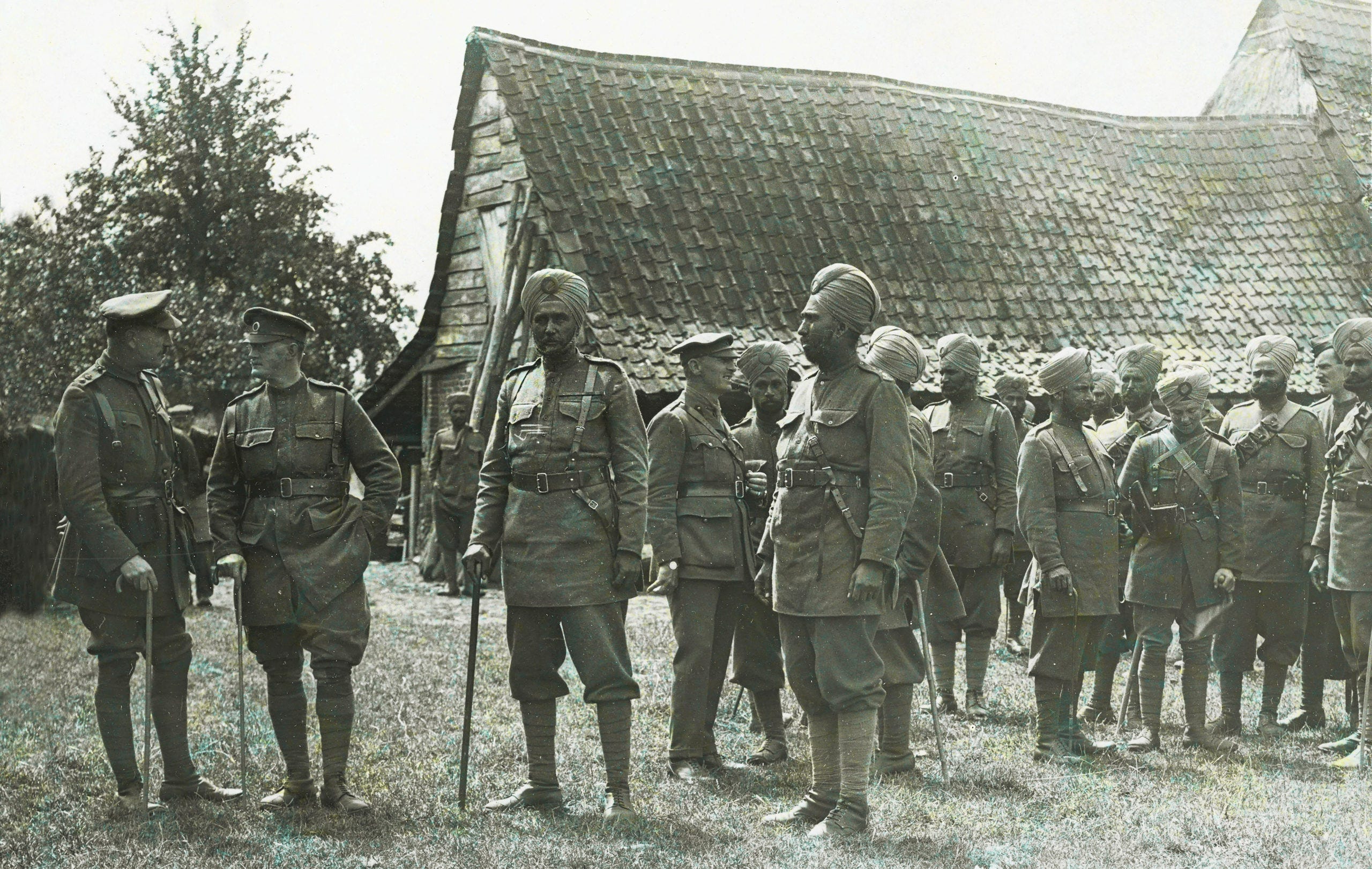
On 31 October 1914, at the village of Hollebeke outside Ypres in Belgium, a 26 year old sepoy named Khudadad Khan was manning a machine gun with 5 other men from the 129th Duke of Connaught’s Own Baluchis.
By the end of the day, all five of his comrades were dead, his British officer had been wounded and the second gun had been destroyed by a shell. Khudadad, himself wounded, kept firing alone until the position was overwhelmed and he was left for dead. He crawled back to his regiment during the night and as a result of his actions he became the first Indian soldier to receive the Victoria Cross.
I have been researching Indian soldiers in the First World War for a while now, and the thing that keeps striking me is not just the scale, which is staggering, especially considering I had always assumed Indian involvement in WW1 was minimal but the geography.
Over 1.5 million Indians served in the war and at least 74,187 died. They fought quite literally across the world. In France, Belgium, Iraq, Turkey, Egypt, Palestine, East Africa, China and Aden. The regimental centres that signed the soldiers up stretch from Peshawar on the Afghan frontier to Lucknow in the Gangetic plain. Their names are inscribed on memorials from the South Downs in Brighton to the banks of the Shatt-al-Arab in Basra.
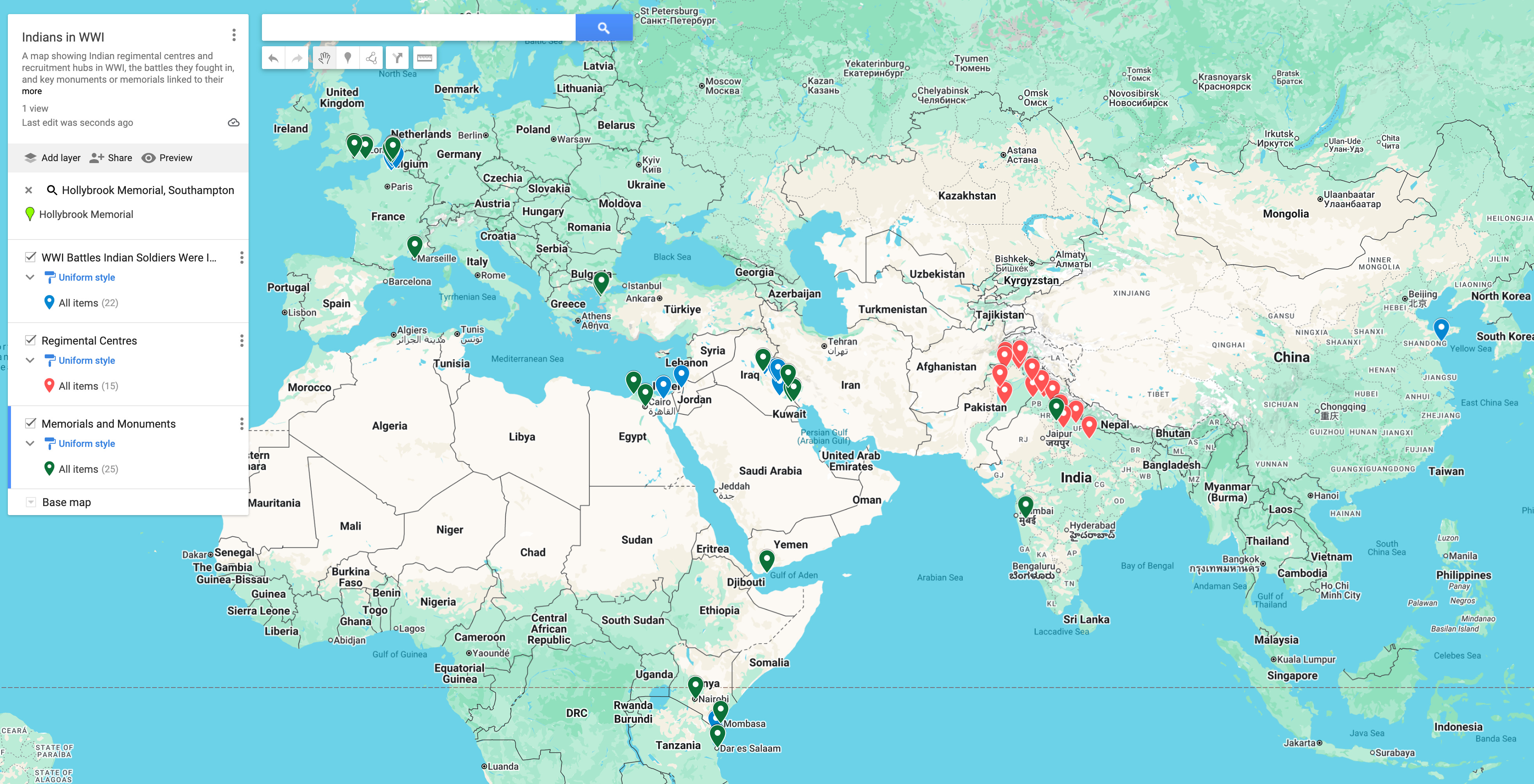
Yet the story of Indian soldiers in the First World War is still largely forgotten. Alongside a new series I’m working on with historians covering every battle involving Indian soldiers in the world wars, starting with WWI, I wanted to map it and help bring it back to the forefront.
We’ve already recorded episodes with Professor Peter Stanley on Gallipoli and Dr Dominiek Dendooven on Ypres, with more to come soon.
Where Indian Soldiers Were Recruited: Punjab, the Frontier, and the United Provinces
If you look at the recruitment geography of the Indian Army in 1914, a pattern emerges immediately. The overwhelming majority of Indian regiments that deployed overseas came from a belt of military towns running across Punjab and the North West Frontier: Firozpur, Jalandhar, Ludhiana, Sialkot, Rawalpindi, Peshawar, Kohat, Abbottabad, Multan, Dera Ismail Khan.
There is a second cluster sat in the United Provinces, covering places such as Meerut, Bareilly, Lucknow, Aligarh and one in what is now Haryana, Ambala.
These were not just garrison towns. They were the institutional heart of the Indian Army.
The 14th King George’s Own Ferozepore Sikhs were raised at Firozpur in 1846, the same year as the First Anglo-Sikh War.
The 15th Ludhiana Sikhs were raised at Ludhiana that same year. The Jullundur Brigade, which would become one of the most famous Indian formations on the Western Front, took its name from Jalandhar.
The 57th Wilde’s Rifles, one of the elite Frontier Force regiments, had deep roots in Kohat.
For some of these soldiers, their fathers and grandfathers had served in the same regiments, in the same towns, under the same regimental colours.
When war broke out in August 1914, the Indian Corps, comprising the 3rd (Lahore) Division and the 7th (Meerut) Division, were mobilised within days. They sailed from Bombay and Karachi in late August and the Lahore Division arrived at Marseille on 26 September 1914, just over six weeks after the declaration of war.
Most of them had never seen Europe, were issued equipment that was inadequate for the conditions they were about to face and within weeks, they were in the trenches.
Where Indian Soldiers Fought in WW1: France, Mesopotamia, Gallipoli, East Africa, and Beyond
The first Indian troops to see action on the Western Front deployed at Hollebeke on 26 October 1914. Khudadad Khan’s action was five days later.
From there, the Indian Corps fought at La Bassée, First and Second Ypres, Neuve-Chapelle, Aubers Ridge, Festubert and Loos. At Neuve-Chapelle in March 1915, the Garhwal Brigade spearheaded what was the first planned British offensive of the entire war. Naik Darwan Singh Negi of the 1st/39th Garhwal Rifles won the Victoria Cross for clearing German trenches in hand to hand fighting.
By late 1915, most Indian infantry had been withdrawn from France and redeployed to Mesopotamia and Egypt. The Indian Cavalry Corps stayed, the Jodhpur Lancers, Deccan Horse, Poona Horse and Jacob’s Horse served on the Western Front until the end of the war, fighting at the Somme, Arras, and Cambrai.
In Mesopotamia, the story is even bleaker. Indian troops formed the overwhelming majority of the force that advanced up the Tigris toward Baghdad. At Ctesiphon in November 1915, around 8,500 men, almost all Indian, attacked 18,000 Ottoman defenders near an ancient arch just 25 miles from Baghdad. They won the battle and lost the campaign. Casualties were so severe that they were forced to retreat to Kut-al-Amara, where 10,000 men were besieged for 147 days. Four relief attempts failed at a combined cost of over 13,000 casualties.
When Kut surrendered on 29 April 1916, the surviving prisoners, most of them India, were force marched to camps in Anatolia where up to 70% of Indian POWs died. It remains one of the worst British military humiliations ever.
Elsewhere, Indian troops fought at Gallipoli from the very first day, the 14th Ferozepore Sikhs landed at Cape Helles on 25 April 1915. Over 3,000 Indian muleteers kept the supply lines running under constant fire and are almost never mentioned. I spoke to Professor Peter Stanley about this in detail on the podcast and the picture he paints is one that most Gallipoli narratives leave out entirely.
In East Africa, the Battle of Tanga in November 1914 was a disaster where poorly trained Indian battalions were thrown against prepared German defences. In the Sinai and Palestine, Indian cavalry were central to Allenby’s campaign. The Jodhpur and Mysore Lancers led the charge at Haifa on 23 September 1918, one of the last great cavalry charges in history.
In a shock to me, Indian soldiers even served in Qingdao, China. The 36th Sikhs joined a Japanese siege of a German held port in what is one of the most obscure theatres of the war.
That is 22 battles across 10 countries and at every single one, the men doing the fighting had been recruited from the same belt of towns the north and north west of British India that I described above.
Indian WW1 Memorials: From Neuve-Chapelle to the Menin Gate to India Gate
This is where the geography becomes most powerful and for some, most uncomfortable.
The principal Indian memorial on the Western Front is the Neuve-Chapelle Indian Memorial in France, designed by Sir Herbert Baker. It commemorates 4,742 Indian soldiers who died in France and have no known grave. The design draws on Indian architectural traditions with a a circular sanctuary modelled on early shrine enclosures and an Ashokan column.
At the Menin Gate in Ypres, 412 Indian names appear on the panels alongside British, Australian, Canadian and South African servicemen. Every evening at 8pm, the Last Post ceremony takes place beneath the gate a tradition unbroken since 1928 except during the German occupation.
In Brighton, the Chattri stands on the South Downs above the city. It’s a white marble dome supported by eight pillars of Sicilian marble, built on the exact site where 53 Indian soldiers were cremated in accordance with Hindu and Sikh rites during the war.
Below it, the Royal Pavilion, with its Mughal-inspired architecture, was converted into a military hospital for Indian soldiers. Over 12,000 men were treated there. Kitchens were adapted for Hindu, Sikh, and Muslim dietary requirements and separate wards were arranged by faith.
In Iraq, the Basra Memorial tells a more difficult story. For over a century, 33,000 Indian soldiers’ names were missing from the memorial. Only British personnel and Indian officers had been inscribed, a decision made by the Indian General Staff in 1918 that prioritised recording British burials. The CWGC has only recently added these names through digital memorial panels. It took a hundred years for the Indian dead at Basra to even be acknowledged by name.
The Heliopolis Memorial in Cairo commemorates 3,727 Indian soldiers who died in Egypt and Palestine with no known grave. The Helles Memorial at Gallipoli carries 1,506 Indian names. In Dar es Salaam and Nairobi, British and Indian memorials stand for the men who died in East Africa. At Maala in Aden, 145 Commonwealth servicemen including Indian soldiers are buried.
In total, I have identified 25 major memorials and commemorative sites connected to Indian soldiers in WW1, spread across 10 countries: France, Belgium, the United Kingdom, India, Iraq, Egypt, Turkey, Tanzania, Kenya and Yemen.
The monuments vary, some are enormous, for instance India Gate in New Delhi is 42 metres high, bearing the names of 74,187 dead. Where as others are almost invisible, for instance, the cremation memorial for 14 Hindu soldiers in Dar es Salaam. Nonetheless, all of them mark the same thing: that men from a handful of garrison towns in undivided India fought and died across more of the globe than most people realise.
The Interactive Map: 68 Locations Across 10 Countries
I have been building an interactive Google Map that plots all of this. 68 locations in total: 22 battlefields, 15 regimental centres and 31 memorials, with more being added regularly.
Every pin contains the full details:
which regiments were there
what happened
casualty figures
the context behind it all
and, where applicable, a podcast episode with a historian exploring the involvement of Indian soldiers in that particular battle.
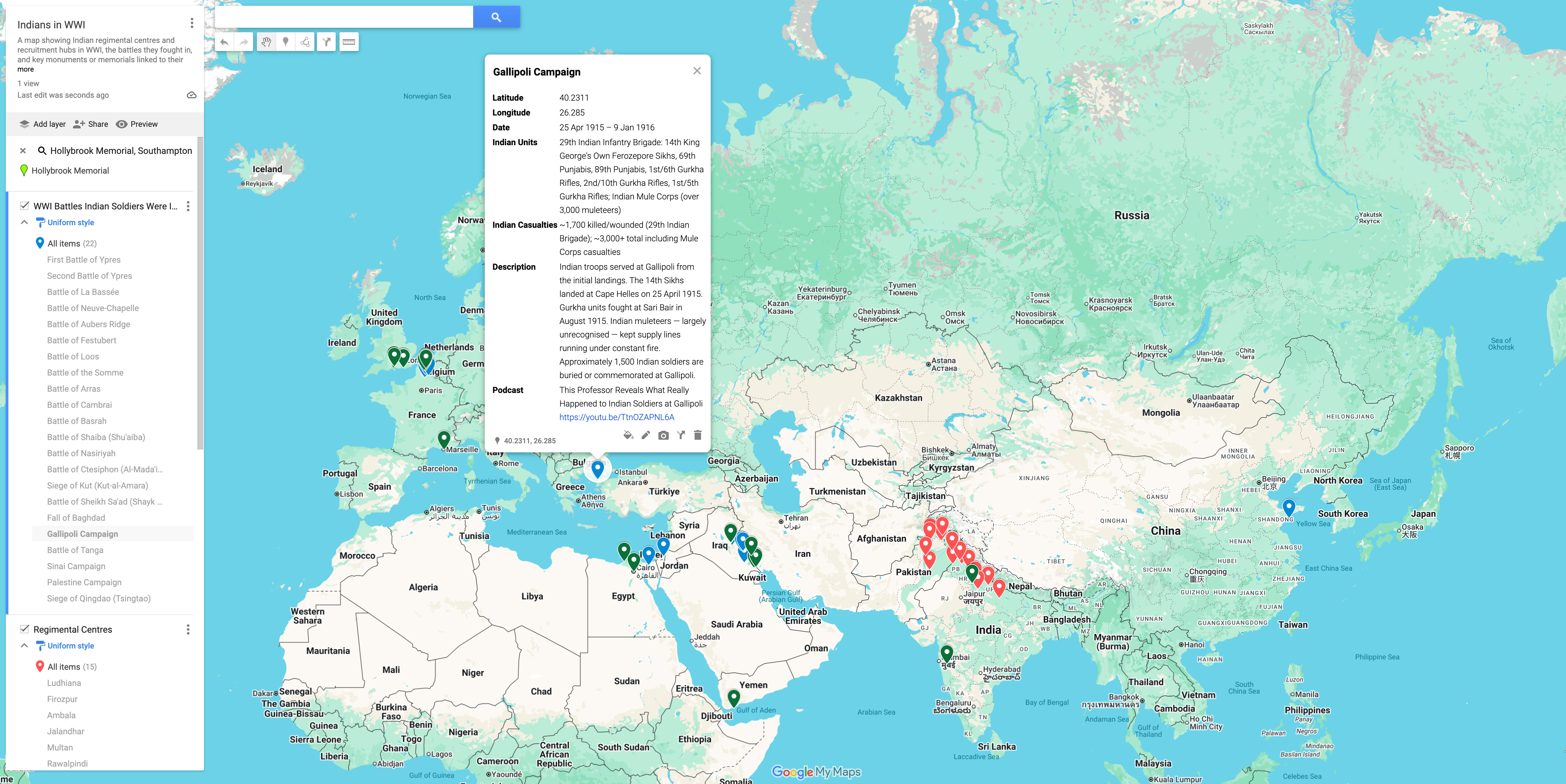
Click on the Siege of Kut and you will see the 6th Poona Division besieged, the four failed relief attempts the 23,000 combined casualties, and the fact that up to 70% of Indian POWs died in captivity after the surrender.
Click on Jalandhar and you will see the Jullundur Brigade that left from there.
Click on Neuve-Chapelle and you will find where their dead are commemorated.
You can zoom out and see the sheer spread, from Qingdao in eastern China to Tanga in East Africa to Hollebeke in Belgium. You can zoom in on Mesopotamia and watch the catastrophe unfold: Basrah, Ctesiphon, Kut, the relief attempts, Baghdad.
This is the kind of resource I wish existed when I first started researching this subject. It is detailed and it is designed to be used, whether you are planning to visit these sites, researching a specific regiment or just trying to understand the scale of what happened.
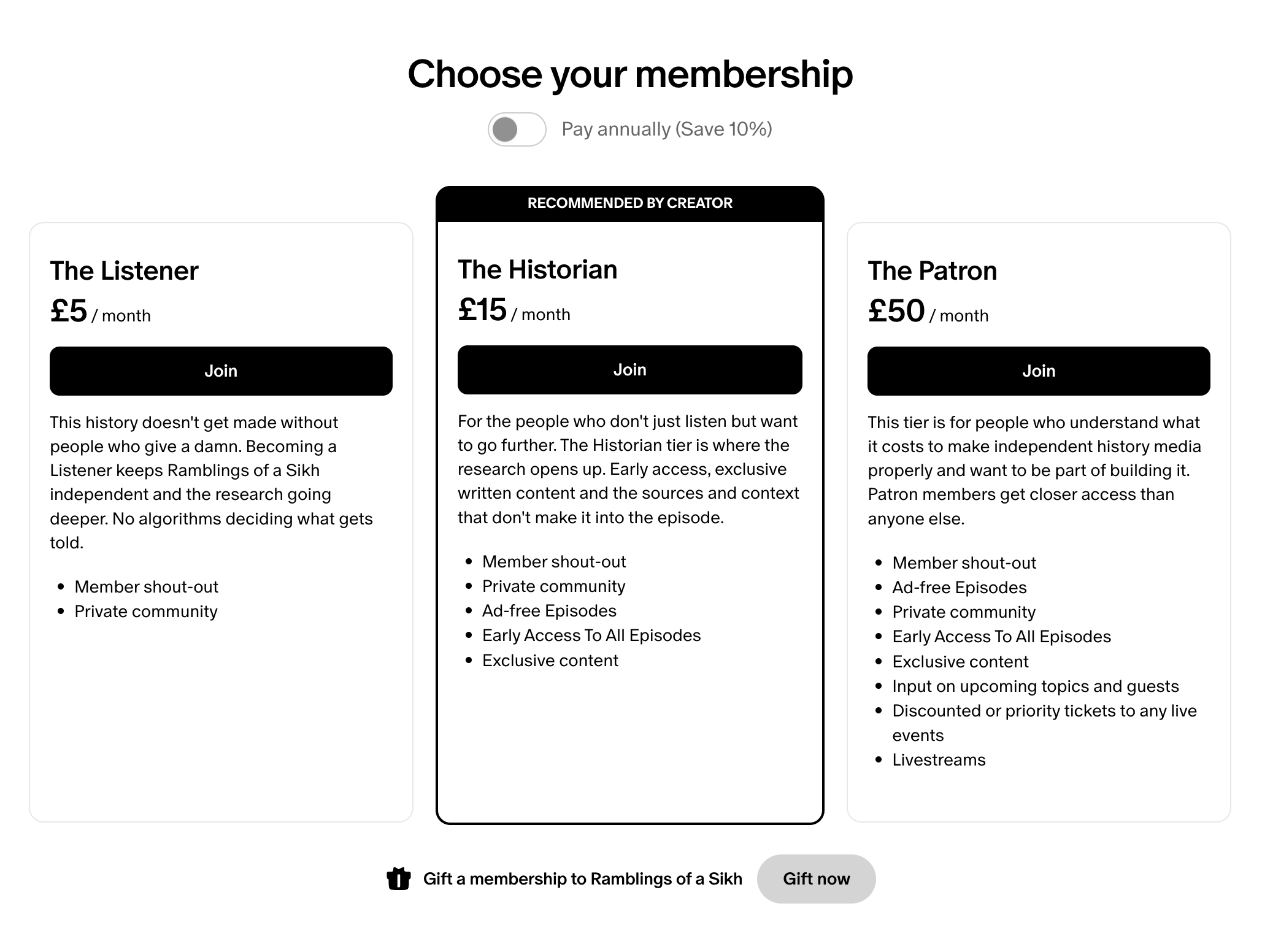
The map is available for a one off £3 purchase on Patreon or included exclusively for Patreon supporters on the Historian tier and above.
Supporters also get ad free episodes, extended interview cuts, annotated reading lists, bonus content, and the material that does not make the final podcast.
We are over a hundred episodes in and have spoken to over fifty academics, historians, journalists and authors. As well as a whole host of other guests and every single one of those conversations produced more than what made it into the published episode. The Patreon is where all of that lives.
Join at patreon.com/ramblingsofasikh
If you follow me on Substack, that is not changing. This is where I write, whether that’s original articles, research series or long form history. The Patreon is where you go deeper into the podcast, the episodes, the extras, and everything around them.